
STP Plant: Full Form, Meaning & How It Works
What STP stands for, why every city and building needs one, and the step-by-step process inside.
Quick Answer
The full form of STP plant is Sewage Treatment Plant. It is a facility that removes solids, organic matter and germs from domestic wastewater so the treated water can be safely discharged or reused. An STP plant works in stages: screening and grit removal, primary settling, biological treatment, secondary settling, tertiary filtration and disinfection, plus sludge handling.
On This Page
- What Is the Full Form of STP?
- STP Plant Meaning in Simple Words
- Why Is an STP Plant Needed?
- How an STP Plant Works: Step by Step
- Main Components of an STP Plant
- Types of STP Plant Technology
- Where Are STP Plants Used?
- The Role of Pumps in an STP Plant
- A Day in the Life of Sewage: A Simple Example
- Common Myths About Sewage Treatment
- Glossary of Common STP Terms
- Quick Checklist: Is Your STP Plant Healthy?
- Frequently Asked Questions
An STP plant is one of those pieces of infrastructure most people never see, yet every city, hospital, hotel and housing society depends on it. If you have searched for the STP full form or wondered what actually happens to the water that leaves your kitchen and bathroom, this guide explains it in plain language.
We will cover what STP stands for, why it matters, how an STP plant works step by step, the main technologies used in India, and the equipment that keeps a plant running every day.
What Is the Full Form of STP?
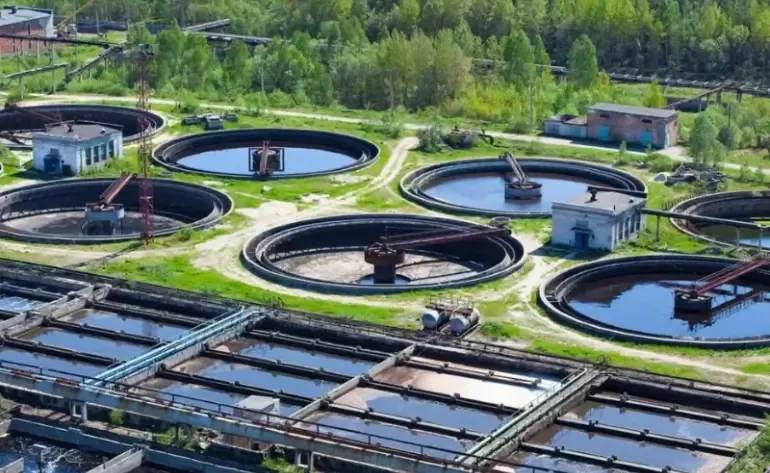
The full form of STP is Sewage Treatment Plant. You may also hear it called a wastewater treatment plant (WWTP) or, in municipal projects, a sewage treatment works. In India, the short form “STP plant” is used everywhere, from builder brochures to pollution control board consents, even though “plant” repeats the P in STP.
A related term you will often see is ETP, which stands for Effluent Treatment Plant. An ETP treats industrial wastewater, while an STP plant treats domestic sewage. We compare the two in detail in our guide on ETP vs STP.
STP Plant Meaning in Simple Words
In simple terms, an STP plant is a system of tanks, pumps, blowers and filters that cleans used household water. Sewage contains about 99.9% water and only a small fraction of solids, but that fraction includes organic matter, nutrients, oils and disease-causing bacteria. The plant separates and breaks down these pollutants so the water that comes out meets discharge standards.
Most STPs rely on bacteria to do the hard work. Air is blown into the sewage, and microorganisms feed on the dissolved organic matter, converting it into carbon dioxide, water and more bacteria. Those bacteria then settle out as sludge, leaving clear water behind. This is the same principle described in the classic activated sludge process.
Why Is an STP Plant Needed?
Untreated sewage is one of the biggest causes of river and groundwater pollution in India. A properly run sewage treatment plant protects health, the environment and, increasingly, the water budget of a building or city.
Public Health
Sewage carries pathogens that cause cholera, typhoid and diarrhoeal disease. Treatment and disinfection break that chain.
Clean Rivers and Lakes
Organic load in raw sewage consumes dissolved oxygen in water bodies, killing fish and causing foul odour.
Legal Compliance
Pollution control boards require STPs for many projects and set limits for BOD, TSS and coliforms in treated water.
Water Reuse
Treated water can be reused for flushing, gardening, cooling towers and construction, cutting fresh water demand.
How an STP Plant Works: Step by Step
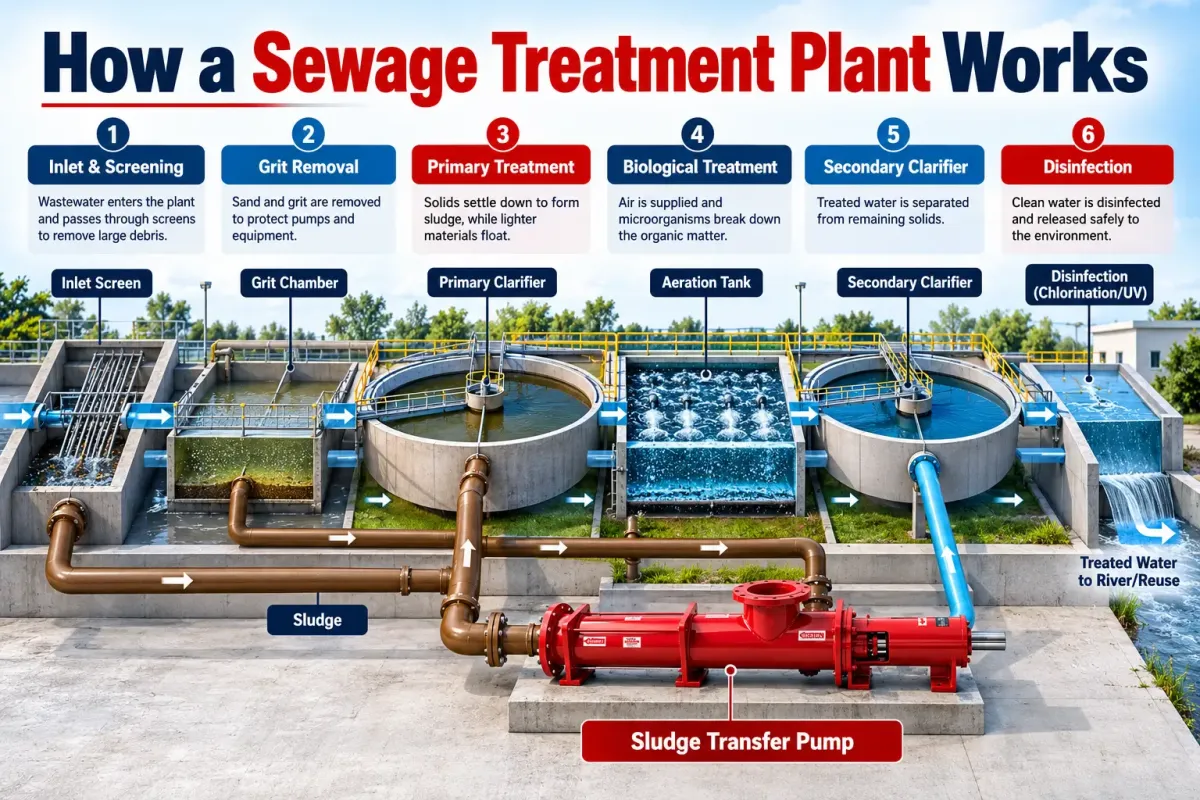
Every STP plant follows the same basic logic: remove the big things first, then the settleable solids, then the dissolved organic matter, and finally polish and disinfect the water. Here is how the stages fit together.
1. Preliminary Treatment: Screening and Grit Removal
Raw sewage first passes through bar screens that catch plastics, rags, cloth and other large objects that would damage pumps. It then flows through a grit chamber where sand and gravel settle out. Oil and grease traps are often added in hotels, hospitals and commercial kitchens.
2. Equalization Tank
Sewage flow is never steady. It peaks in the morning and evening and drops at night. An equalization tank stores the incoming sewage and lets transfer pumps feed the biological stage at a steady rate, which keeps treatment stable. Coarse bubble aeration in this tank prevents septic conditions and odour.
3. Primary Treatment: Settling
In larger plants, a primary clarifier allows heavier suspended solids to settle by gravity. This removes a meaningful share of suspended solids and some of the organic load before biological treatment. Many smaller packaged STPs skip this stage and go straight to biological treatment.
4. Secondary (Biological) Treatment
This is the heart of the STP plant. In an aeration tank, blowers supply oxygen through diffusers, and microorganisms consume dissolved organic matter. The technology used here gives the plant its name: activated sludge (ASP), extended aeration, MBBR, SBR or MBR. Each has trade-offs in space, power and output quality, which we explain in our MBBR vs SBR vs MBR comparison.
5. Secondary Clarifier or Tube Settler
The mixture of water and bacteria flows into a settling tank. The biological solids, now called activated sludge, settle at the bottom. Part of this sludge is pumped back to the aeration tank (return activated sludge) to keep the bacteria population healthy, and the excess is sent to sludge handling.
6. Tertiary Treatment and Disinfection
To reach reuse quality, clarified water passes through a pressure sand filter and an activated carbon filter to remove fine suspended solids, colour and odour. It is then disinfected with chlorine (sodium hypochlorite dosing) or UV, sometimes with ultrafiltration added for very high quality reuse.
7. Sludge Handling
Excess sludge is thickened and then dewatered using a filter press, screw press, centrifuge or sludge drying beds. Polymer is dosed to help the solids bind together. The dewatered cake is disposed of or used as manure where permitted.
An STP plant is only as reliable as its weakest stage. A single clogged sludge pump or a failed blower can upset the entire biological process.
Main Components of an STP Plant
The table below lists the key equipment you will find in a typical sewage treatment plant and what each one does.
| Component | Purpose |
|---|---|
| Bar screen and grit chamber | Removes floating debris, rags, sand and grit |
| Equalization tank | Balances variable sewage flow and load |
| Raw sewage and transfer pumps | Lift and move sewage between stages |
| Aeration tank with diffusers | Biological breakdown of organic matter |
| Air blowers | Supply oxygen to the bacteria |
| Clarifier or tube settler | Separates treated water from biological sludge |
| Sludge recirculation and transfer pumps | Return activated sludge and send excess sludge for dewatering |
| Pressure sand and activated carbon filters | Polish water for reuse |
| Chemical dosing pumps | Dose chlorine, polymer, alum or lime accurately |
| Filter press, screw press or drying beds | Dewater sludge into a handleable cake |
Types of STP Plant Technology
The biological stage can be built using several technologies. The right choice depends on the available land, required treated water quality, power cost and how skilled the operators are.
- Activated Sludge Process (ASP) and Extended Aeration: the traditional, proven method. Needs more space but is simple to understand.
- MBBR (Moving Bed Biofilm Reactor): plastic media carriers hold the bacteria, giving a compact plant that handles load swings well. Very popular in apartments.
- SBR (Sequencing Batch Reactor): treatment and settling happen in the same tank in timed cycles. Good for nutrient removal and variable flows.
- MBR (Membrane Bioreactor): membranes replace the clarifier, giving very high quality water in a small footprint, at a higher cost.
- Packaged or prefabricated STP: factory-built units for small capacities, explained in our guide to packaged STPs.
Where Are STP Plants Used?
An STP plant can be sized for a single building or for an entire city. Common applications include:
- Residential apartments, gated communities and townships (see STP plant for apartments)
- Hotels, resorts, hospitals and malls
- Schools, colleges and IT parks
- Factory townships and the domestic sewage from industrial units
- Municipal sewage treatment for towns and cities
The Role of Pumps in an STP Plant
Water does not flow uphill by itself, and sewage contains solids that settle and clog. That is why pumps are working at almost every stage of an STP plant: lifting raw sewage, transferring it from the equalization tank, recirculating sludge, feeding the filter press and dosing chemicals.
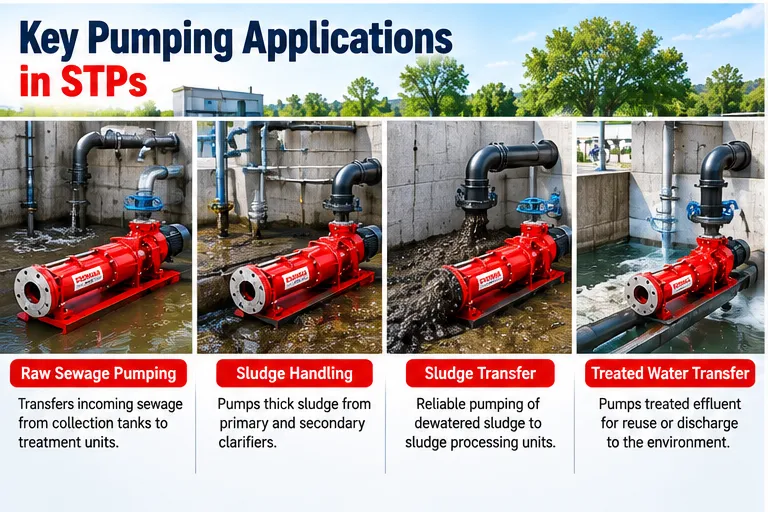
Sludge duties are the toughest. Thick, abrasive sludge needs a pump that moves it gently without clogging, which is why a progressive cavity pump is the standard choice for sludge transfer and filter press feed. Accurate chemical addition calls for reliable dosing pumps. For a full breakdown of every pumping duty, read our complete STP pump guide.
Ropman Engineering Corporation manufactures progressive cavity, wide throat and dosing pumps for sewage treatment plants in Meerut, India, with rotors and stators made in-house. Learn more about our wastewater, ETP and STP solutions, or read the background on sewage treatment.
A Day in the Life of Sewage: A Simple Example
Imagine a housing society of 200 flats. Between 6 and 9 in the morning, showers, toilets and kitchens send a surge of wastewater into the sewer line. By the time it reaches the treatment area, it carries hair, food scraps, soap, plastics that should never have been flushed, and dissolved organic matter that cannot be seen at all.
The screen catches the plastics and rags first. The grit chamber lets sand from floor washing drop out. The water then rests in the equalization tank, which fills during the morning rush and slowly empties through the afternoon and night, so the biology downstream receives a steady diet instead of a flood.
In the aeration tank, billions of bacteria go to work. Within several hours, most of the dissolved organic load has been consumed. The mixture moves to the settler, where the bacteria clump together and sink. The clear water at the top flows on through sand and carbon filters, receives a measured dose of chlorine, and is stored in a treated water tank. By evening, the same water that left the bathrooms in the morning is flushing toilets and watering the society’s lawns.
Meanwhile, the settled sludge does not stay idle. A share of it is pumped back to the aeration tank to keep the bacteria population strong. The rest is pumped to a holding tank, mixed with polymer and squeezed in a filter press into a cake that can be carried away. Each of these moves depends on a pump doing its job quietly in the background.
Common Myths About Sewage Treatment
| Myth | Fact |
|---|---|
| Treated sewage is still dirty water | Properly treated and disinfected water meets strict norms and is widely reused for flushing, gardening and cooling. |
| An STP always smells | A healthy plant has little odour. Smell is a sign of low aeration, old sludge or poor maintenance. |
| A septic tank does the same job | A septic tank only settles solids. It does not remove dissolved organic matter to discharge standards. |
| Bigger is always safer | A heavily oversized plant can struggle because the bacteria do not get enough food to stay healthy. |
| Once built, the plant runs itself | Every plant needs daily checks, regular sludge removal and planned maintenance. |
Glossary of Common STP Terms
Sewage treatment comes with a lot of shorthand. These are the terms you will hear most often from consultants, operators and pollution control boards.
- KLD / MLD: kilolitres per day and million litres per day, the units for plant capacity.
- BOD: Biochemical Oxygen Demand, a measure of biodegradable organic pollution.
- COD: Chemical Oxygen Demand, a measure of total oxidisable pollution.
- TSS: Total Suspended Solids, the particles still floating in the water.
- MLSS: Mixed Liquor Suspended Solids, the concentration of bacteria in the aeration tank.
- DO: Dissolved Oxygen, the oxygen available to the bacteria.
- HRT: Hydraulic Retention Time, how long the water stays in a tank.
- RAS / WAS: Return Activated Sludge and Waste Activated Sludge.
- SV30: the volume of sludge that settles in a one-litre jar in 30 minutes, a quick health check.
- Tertiary treatment: polishing steps such as filtration and disinfection after biological treatment.
Quick Checklist: Is Your STP Plant Healthy?
Signs of a well-run plant:
- Treated water is clear, with no colour or smell
- The aeration tank has even bubbling and a light brown, earthy-smelling liquid
- Sludge settles well in the SV30 jar and the water above it is clear
- Pumps and blowers run without unusual noise or heat
- Sludge is removed and dewatered on a fixed schedule
- Lab reports show BOD, TSS and coliforms within consent limits
- A logbook is filled in every day
If several of these are missing, the plant needs attention. Our STP maintenance checklist explains what to check daily, weekly and monthly, and our guide to CPCB STP norms lists the limits your treated water must meet.
Frequently Asked Questions
What is the full form of STP plant?
What is the difference between STP and ETP?
How does an STP plant work?
Which technology is best for an STP plant?
Can STP treated water be reused?
Is a septic tank the same as an STP?
How long does sewage stay in an STP?
What happens to the sludge from an STP plant?
Need Reliable Pumps for Your STP Plant?
Ropman builds progressive cavity, wide throat and dosing pumps for every stage of a sewage treatment plant. Share your capacity and duty, and we will recommend the right pump.
Request a Quote